Components:
Lipids:
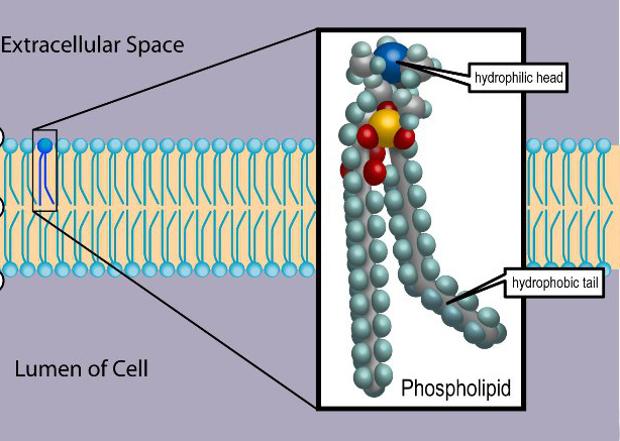
Phospholipids are the main lipid components in the cell membrane. These lipids are composted of glycerol, two fatty acid tails, and a phosphate-linked head group. They are also amphipathic, meaning that they have a hydrophobic and hydrophilic region. The hydrophilic or "water-loving" portion of the phospholipid is its head, which contains a negatively charged phosphate group and a varying additional small group. These heads face outwards in the lipid bilayer structure. Their hydrophobic or "water-hating region" is its fatty acid tails. These nonpolar tails face inwards in the lipid bilayer. Together these regions create a good barrier between the interior and exterior of the cell because water and other polar or charges substances cannot easily cross the hydrophobic core of the membrane.
Along with phospholipids the membrane also contains lipids called carbohydrates. These are located on both the inside and outside of the cell, either attached to proteins (forming glycoproteins) or lipids (forming glycolipids). Carbohydrates are used both for resistance to temperature changes and for cell to cell recognition. Carbohydrates alsoform a coat around the cell called a glycocalyx, this is a first layer of defense for the cell membrane.

Proteins:
Within the subject of proteins comes two major types: integral and peripheral. Integral proteins are integrated into the membrane. Some stick partway into the membrane while others extend the entire membrane. These are called transmembrane proteins. Peripheral proteins are found on the outside and inside surfaces of the membrane. Unlike integral proteins, peripheral proteins do not stick to the hydrophobic core of the membrane, and they tend to be more loosely attached.
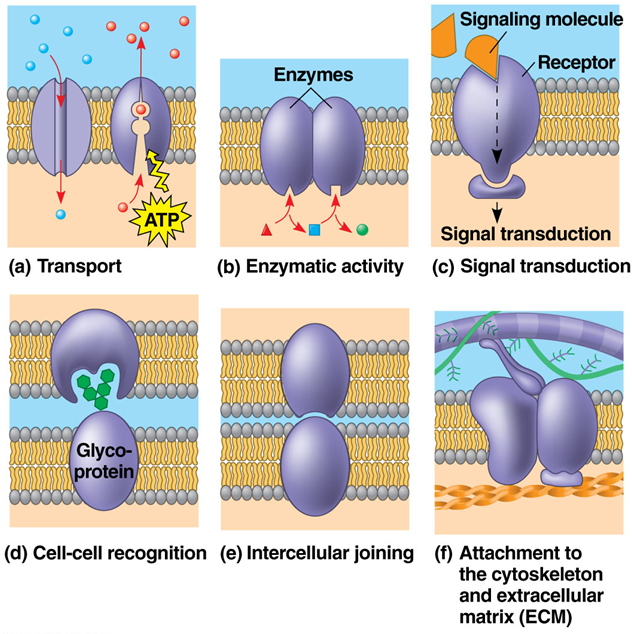
Proteins determine most of the membrane's functions. Different types of cells contain sets of membrane proteins and the various membranes within the cell have a unique set of proteins. To the left we can see the function of six major types of membrane proteins. Transport proteins (a) can either provide a hydrophilic channel across the membrane that is selective for a particular solute (left), or they may shuttle substances across the membrane by changing shape. Some of these proteins hydrolyze ATP as a source of energy to pump substances across. Enzymatic proteins (b) are built into the membrane with its active site exposed to substances in the adjacent solution. Signal transduction proteins (c) can be receptors, which may have a binding site with a specific shape that fits the shape of a chemical messenger like a hormone. The signaling molecule may cause a change in shape in the protein that relays a message to the inside of the cell. Some proteins are used for cell to cell recognition (d). Glycoproteins can serve as identification tags that are specifically recognized by membrane proteins of other cells. Others are used for intercellular joining (e). Membrane proteins of adjacent cells hook together in various types of junctions. Finally, proteins are used for attachment to the cytoskeleton and extracellular matrix (f). Microfilaments or other elements of the cytoskeleton may be noncovalently bound to membrane proteins which helps to maintain cell shape and stabilize the location of certain membrane proteins.
A single cell may have membrane proteins carrying out several of these functions. These proteins help the membrane to be a functional mosaic as well as a structural one.