Fluid Mosaic Model:
The currently accepted model of the cell membrane is known as the Fluid Mosaic Model. According to the model, the plasma membrane is a mosaic of freely and fluidly moving components. The general consistency is compared to that of olive oil. This means that if you were to stick a very fine needle into the cell, the membrane will simply flow around it, and when the needle is removed, the membrane will flow back together seamlessly. This movement is typically lateral, but a lipid flip flopping across a membrane is quite rare. What causes this to occur? A membrane is held together primarily by hydrophilic interactions, which are much weaker than covalent bonds. Different elements of the membrane move at different rates, however the movement of phospholipid in the membrane is rapid. Proteins are larger and therefor move much slower, but some membrane proteins do drift. Fluidity of the membrane is the reason that our membrane doesn't fall apart when it gets too hot, or solidify when It gets too cold.
What affects fluidity?
Temperature and Lipid Composition:
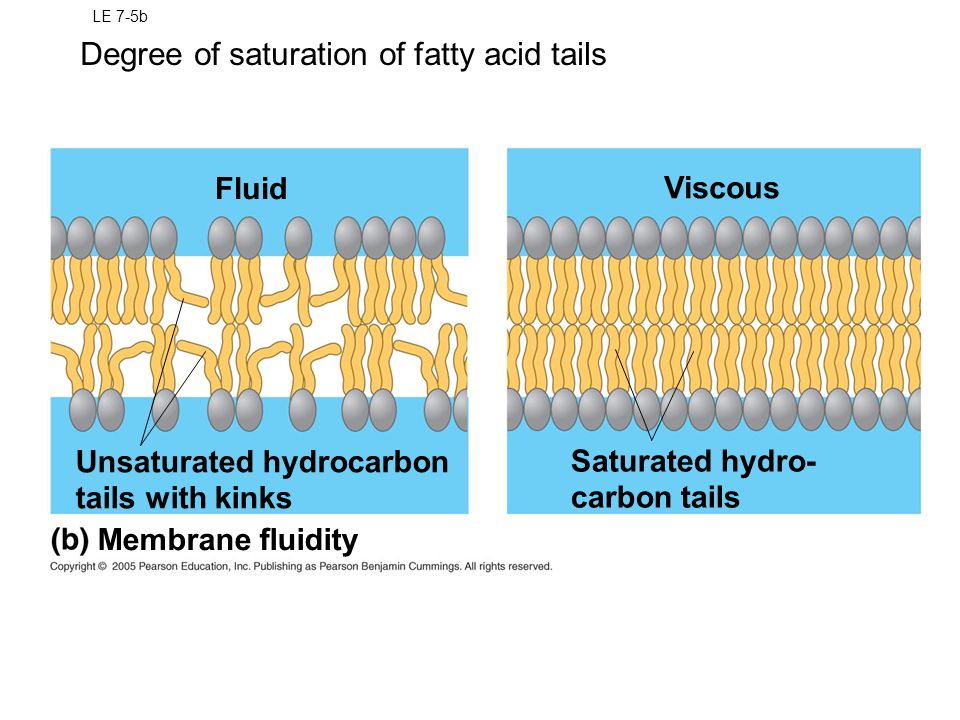
Just a reminder, temperature usually would cause the membrane either to solidify at cold temperatures or fall apart at extremely cold ones. The plasma membrane is able to remain resistant to temperature decreases until the phospholipids become packed together, and the membrane solidifies, decreasing fluidity. Increasing temperatures also increase fluidity. How drastically temperature influences membrane fluidity depends on the composition of the phospholipids. The membrane remains fluid to a lower temperature if there are more phospholipids with unsaturated hydrocarbon tails. These lipids have kinks in their tails, meaning that they cannot pack together as closely and the membrane stays more fluid.
Most membranes contain a mixture of phospholipids, some with two saturated (straight) tails and other with one saturated and one unsaturated (bent) tail. Many organisms, such asfish and many plants, are able to adjust the percentage of unsaturated phospholipids to adjust to the changing temperatures of the seasons.
Cholesterol and Temperature:
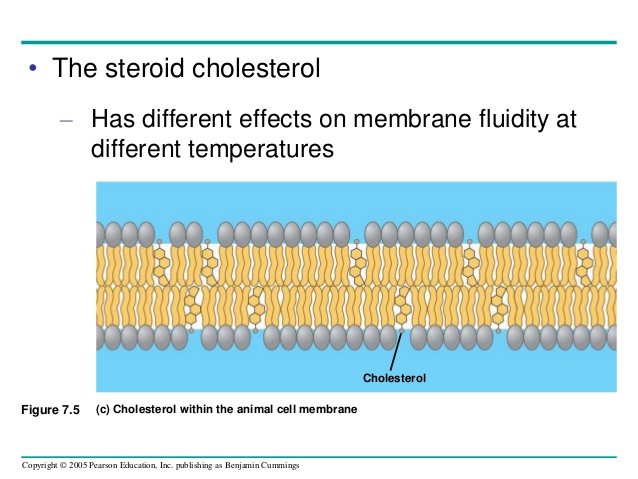
The steroid cholesterol is wedged between phospholipid molecules in the plasma membrane. This substance has different effects on fluidity at different temperatures. At higher temperatures the cholesterol makes the membrane less fluid by restraining phospholipid movement. However, at lower temperatures it increases movement by preventing the close packing of the membrane. Cholesterol is thought to be a temperature "buffer", resisting changes in fluidity caused by temperature.