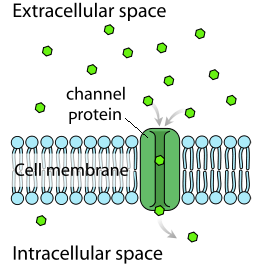
Channel Proteins:
Channel proteins are a specific type of transport protein, in which certain molecules or atomic ions and tunnel through the membrane in a hydrophilic channel. For example, the passage of water molecules through a membrane in certain cells is greatly facilitated by channel proteins known as aquaporins.
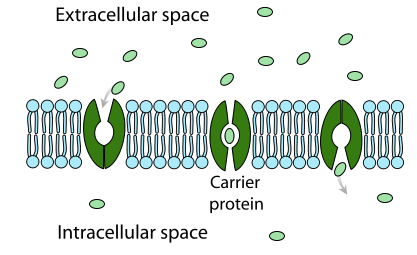
Carrier Proteins:
Carrier proteins are another type of transport protein in which the protein holds onto the substances and change shape in a way that shuttles them across the membrane. A transport protein is specific for the substance it moves.
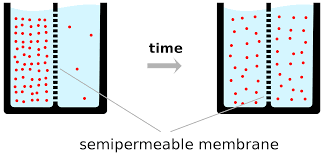
Passive Transport:
Passive transport is defined as diffusion of a substance across a biological membrane. Passive transport requires no energy to make it happen. To understand passive transport you must first understand diffusion. Diffusion is the movement of molecules of any substance so that they spread out evenly into available space. Molecular movement is random, however diffusion of a population of molecules may be directional. If the entire concentration of a substance is located on one side of a membrane, the substance will continue to move until both sides of the membrane have an equal concentration. Simply stated, diffusion is the movement of a substance from an area of high concentration to an area of low concentration, meaning in moves down the concentration gradient. Much of the traffic across the cell membrane occurs by diffusion.
Facilitated Diffusion:
Facilitated diffusion is the transport of molecules across the plasma membrane with the assistance of transport proteins. As mentioned earlier, there are two types of transport proteins: carrier and channel proteins. Another group of channel proteins are ion channels, which function as gated channels. These open and close in response to stimulus. This stimulus may be chemical or electrical, and if it is chemical, the stimulus is a substance other than the one being transported. Despite the help of transport proteins, facilitated diffusion is considered passive transport because the solute is moving down its concentration gradient.
Active Transport:
Active transport is the movement of a molecule against its concentration gradient, therefore expending energy. The transport proteins that move solutes against a concentration gradient are all carrier proteins rather than channel proteins. There are two main types of active transport: primary and secondary. Primary active transport directly uses a source of energy, such as ATP, to move molecules across the gradient. Secondary active transport (cotransport) uses an electrochemical gradient as an energy source.
Sodium Potassium Pump:
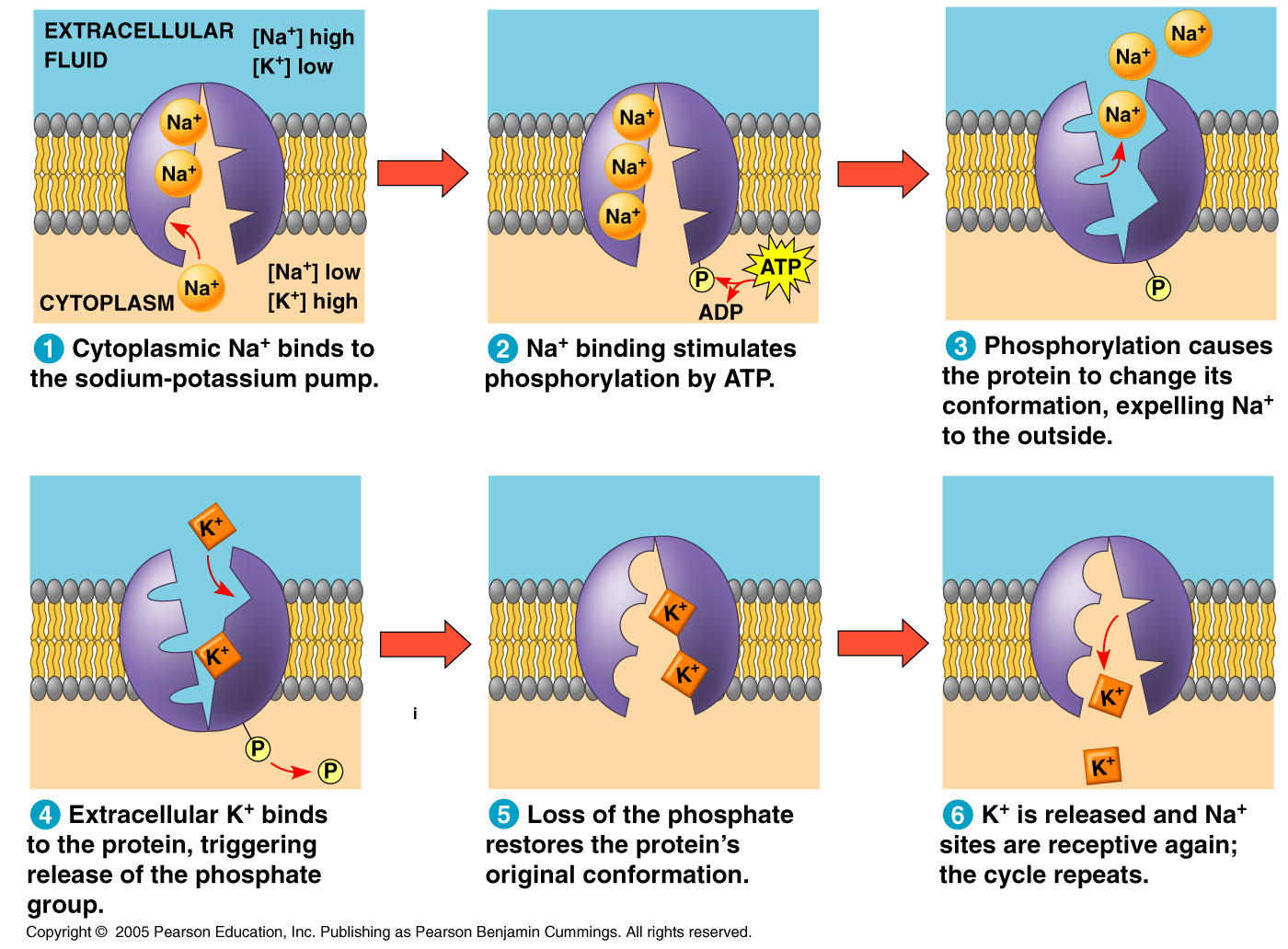
ATP is responsible for a majority of energy used for active transport . One way it is able to power this is by transferring a phosphate group directly to the transport protein, which in turn with cause it to change its shape to allow the solute across the membrane. An example of a system that works like this is the sodium potassium pump, which exchanges sodium for potassium across the plasma membrane of animal cells.
In order to understand the sodium potassium pump, we must first understand some other ideas. First, we have already discussed the idea of a concentration gradient, but there is also such thing as a electrochemical gradient. The cytoplasm of a cell is typically negative in charge relative to the extracellular fluid due to uneven distribution of anions and cations. Due to this difference in charge, living cells typically have what is called membrane potential, an electrical potential difference (voltage) across their cell membrane. Because the inside of the is negative compared to the outside, the membrane potential favors the passive transport of cations into the cell and anions out of the cell. This means two forces drive the diffusion of ions across the membrane: a chemical and electrical. This combination of forces acting on an ion is called the electrochemical gradient.
The sodium potassium pump transports sodium out of the cell while it brings potassium in and a cycle. In each cycle three sodium ions exit the cell while two potassium ions enter, meaning there is a net transfer of one positive charge from the cytoplasm to the extracellular fluid, which stores energy as voltage. A transport protein that generates voltage across a membrane is called an electrogenic pump. The sodium potassium ion pump is the primary electrogenic pump of animal cells. The main electrogenic pump of plants, fungi, and bacteria is a protein pump which actively transports hydrogen ions (protons) out of the cell.
Cotransport:
Cotransport, also known as secondary transport, is when a singe ATP-powered pump that transports a specific solute can indirectly drive the active transport of several other solutes. A substance that has been pumped across a membrane can do work as it moves back across the membrane by diffusion. Another transport protein, called a cotransporter separate from the pump, can couple the "downhill" diffusion of the substance to the "uphill" transport of the second substance against its own concentration gradient.
Bulk Transport
Small molecules are able to pass through the membrane by diffusion or through a transport protein. However, large molecules such as proteins and polysaccharides generally cross the membrane in bulk by mechanisms that involve packing by vesicles. This is a form of active transport.
Exocytosis:
AS much as cells need to ingest materials, they also need to release them, such as signaling proteins and waste products. Exocytosis is a form of bulk transport in which materials are transporter from the inside to the inside to the outside of the cell in membrane-bound vesicles. These vesicles come from the Golgi apparatus and when the vesicle membrane and the plasma membrane came into contact the lipid of the two bilayers rearrange themselves so that the two membranes can fuse. Some vesicles fuse completely with the membrane and others fuse just enough to release their contents and pinch off, returning to the cell interior.
Endocytosis:
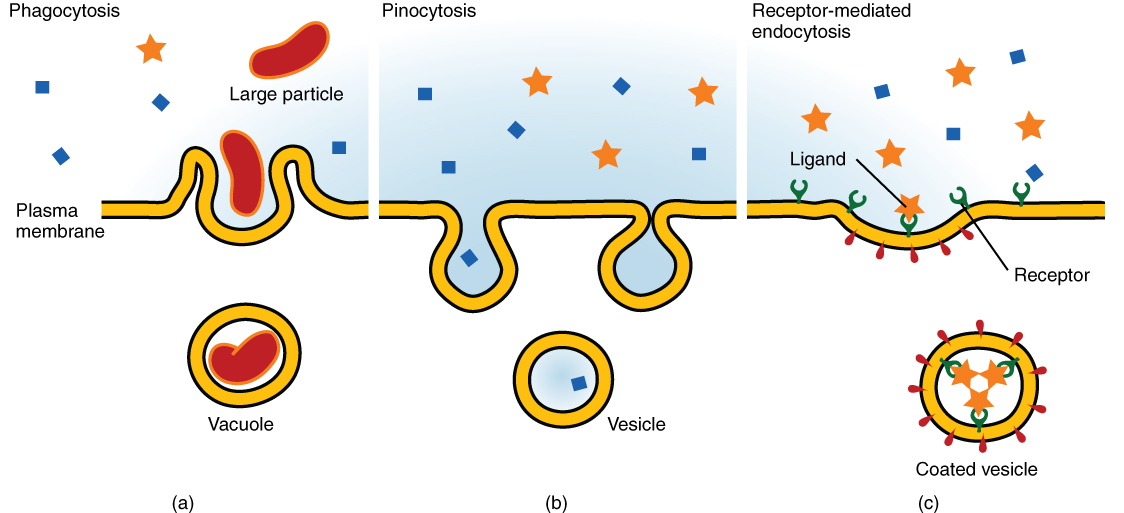
Endocytosis is a term that generalizes the concept of active transport that moves particles into the cell by enclosing them in a vesicle made out of plasma membrane. A small area of the plasma membrane sinks in to from a pocket around the target substance . The pocket then pinches off with the help of specialized proteins, leaving the particle trapped in a newly created vesicle or vacuole inside the cell. There are three types of endocytosis: phagocytosis, pinocytosis, and endocytosis:
Phagocytosis literally means "cell-eating." In this process large particles are engulfed by the cell's pseudopodia and packed into a membrane enclosed sac. Once the particle has been engulfed, the pocket containing the particle will pinch off from the membrane, forming a membrane bound compartment called a food vacuole. The vacuole will then be broken down when it binds with a ligand containing hydrolytic enzymes.
Pinocytosis is defined as "cell drinking," in which the cell takes in small amounts of extracellular fluid. It is not the extracellular fluid the cell needs, but the molecules dissolved within it. Similar to phagocytosis, the cell takes in the small droplets of fluid in small vesicles.
Receptor-mediated endocytosis is a bit more complicated than the other two forms of endocytosis. This process allows the cell to acquire large amounts of specific substances, even if they are not concentrated in the extracellular fluid. In receptor-mediated endocytosis, receptor proteins on the cell surface are used to capture a specific target molecule. The receptor proteins are gather in regions called coated pits. When specific substances (ligands) bind to the receptors, the coated pit forms a vesicle containing the ligand molecules. The coat proteins found In the coated pits give the vesicle its round shape and help to bud off from the membrane. After this ingested material is freed from the vesicle, the receptors are recycled to the plasma membrane by the same vesicle.